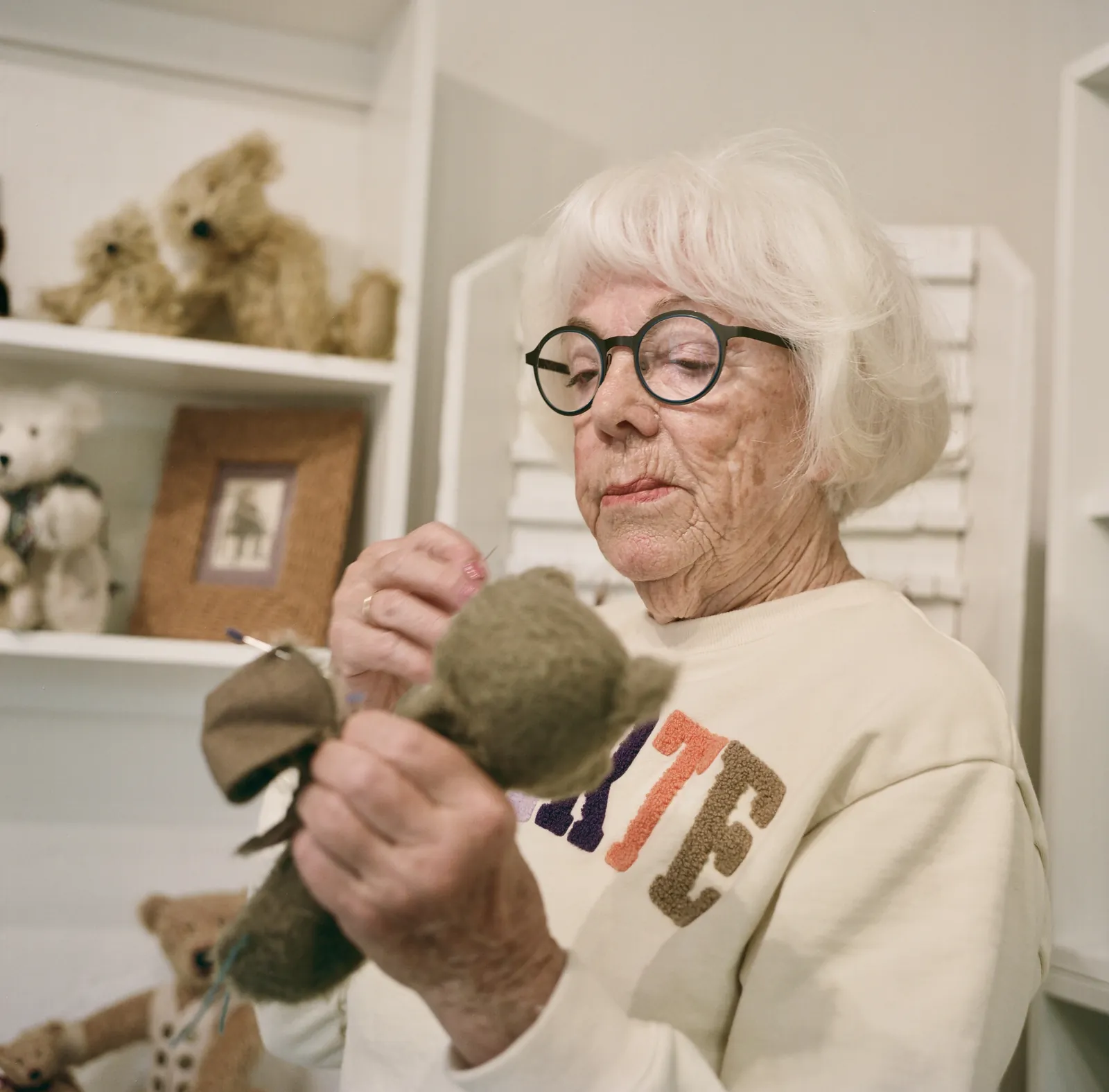
I shoot on many different cameras, but the only one I keep coming back to for my professional work is the Rolleiflex. It's a twin-lens reflex built in 1959. No autofocus, no light meter, no screen. When I first started shooting with it, I would get more poor photos than good ones. After some time that pattern has flipped, but I still have to accept it's an imperfect and tricky process. I've stuck with it for its magical rendering and sharpness, but also because it tends to bring out a special smile in people.
The first thing you notice is that I look down into it, not out at you. The Rolleiflex has a waist-level finder: I hold it at my chest and look down onto a piece of ground glass. There's no big black lens covering my face, so we keep eye contact, and people relax more than they do with a camera pointed straight at them.
Then there's the frame. It's square, six by six centimetres on 120 film, far larger than a 35mm negative, which is where the depth and fine grain come from. The Carl Zeiss Planar lens renders skin in a way I've never managed to match digitally. And the shutter is nearly silent. Half the time people don't realise I've taken the photograph.
Mostly, though, it's the routine: winding on by hand, reading the light myself, composing slowly on the glass. The camera sets the pace. It was built in 1959 and it still makes the best photographs I know how to make.